
Lihat juga


 02.07.2026 01:39 PM
Trade Review and Trading Recommendations for the Euro
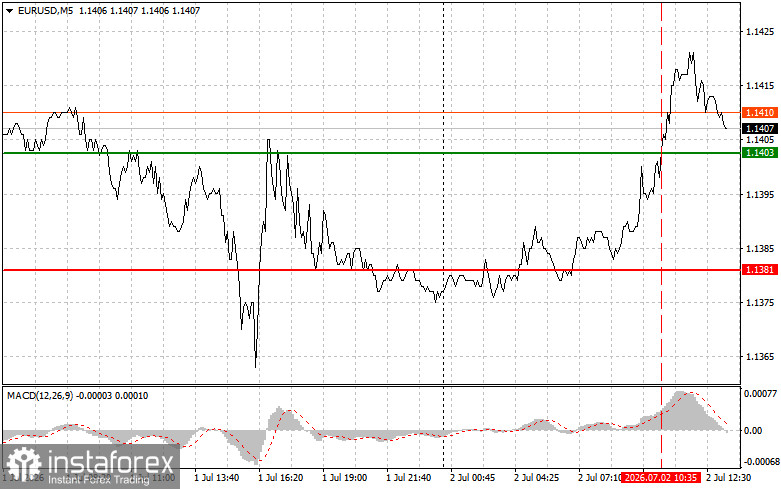
The test of the 1.1403 price level occurred when the MACD indicator had already moved significantly above the zero line, limiting the pair's upward potential. For this reason, I did not buy the euro.
The euro strengthened following the release of eurozone unemployment data, which showed that the unemployment rate declined to 6.2% in May. This is a genuinely positive signal, indicating that the region's economic recovery remains on track. Lower unemployment reflects stronger business activity, increased production, and, consequently, higher consumer demand. The decline to 6.2% marks the lowest unemployment rate recorded in several years.
Following the relatively reassuring labor market report, market attention will now turn to the upcoming U.S. data releases, which are expected to provide a more detailed picture of the state of the U.S. economy. The June U.S. Nonfarm Payrolls (NFP) report will be released shortly. As one of the key indicators of economic activity, it will help assess whether job creation remained resilient during the first month of summer and whether the current positive trend can be sustained.
The U.S. unemployment rate also deserves close attention. Any changes in this indicator directly reflect the condition of the labor market and the economy's ability to absorb the available workforce. Taken together, these data will provide a more comprehensive assessment of the current state of the U.S. economy. Stronger-than-expected figures are likely to support renewed demand for the U.S. dollar.
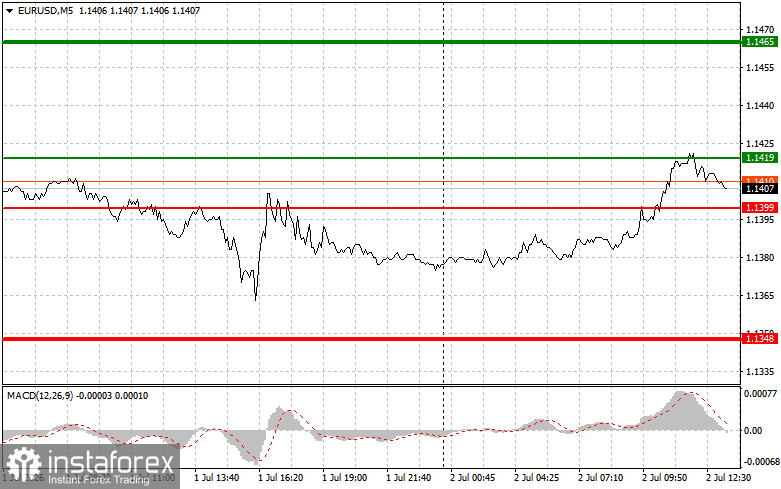
As for my intraday strategy, I will primarily rely on the implementation of Scenario No. 1 and Scenario No. 2.
Scenario No. 1: Consider buying the euro if the price reaches 1.1419 (the green line on the chart), with a target at 1.1465. I plan to exit long positions at 1.1465 and consider opening short positions from that level, targeting a 30–35 point move in the opposite direction. The euro is likely to strengthen today if the U.S. data disappoint. Important: Before buying, make sure the MACD indicator is above the zero line and has just begun moving higher.
Scenario No. 2: I also plan to buy the euro if the price tests 1.1399 twice consecutively while the MACD indicator is in oversold territory. This would limit the pair's downward potential and trigger a bullish market reversal. In this case, the expected upward targets are 1.1419 and 1.1465.
Scenario No. 1: I plan to sell the euro once the price reaches 1.1399 (the red line on the chart). The target is 1.1348, where I intend to exit short positions and consider opening long positions immediately, targeting a 20–25 point rebound. Selling pressure on the pair is likely to return if the U.S. economic data come in stronger than expected. Important: Before selling, make sure the MACD indicator is below the zero line and has just begun moving lower.
Scenario No. 2: I also plan to sell the euro if the price tests 1.1419 twice consecutively while the MACD indicator is in overbought territory. This would limit the pair's upward potential and trigger a bearish market reversal. In this scenario, the expected downward targets are 1.1399 and 1.1348.
Important: Beginner Forex traders should exercise caution when making trading decisions. It is generally advisable to stay out of the market before the release of major economic data to avoid sharp price swings. If you choose to trade during news releases, always use stop-loss orders to minimize potential losses. Trading without stop-loss orders can quickly result in substantial losses, particularly if you trade large position sizes without proper risk management.
Remember that successful trading requires a well-defined trading plan, such as the one outlined above. Making spontaneous trading decisions based solely on short-term market movements is generally an ineffective approach to intraday trading.


