
یہ بھی دیکھیں


 30.06.2026 01:05 PM
Trade Review and Trading Recommendations for the Euro
Due to low market volatility, the price did not reach the key levels I identified during the first half of the day, leaving me without any trade entry opportunities.
The euro showed restrained volatility despite responding positively to encouraging economic data from Germany. Germany's unemployment rate unexpectedly declined in June, exceeding analysts' expectations and providing a positive surprise for traders. According to the published data, the number of unemployed people in Germany fell by 1,000, significantly outperforming forecasts, which had projected an increase of 7,000. This development points to the resilience of the German labor market and its ability to withstand current economic challenges. At the same time, retail sales data also came in stronger than expected, indicating steady consumer demand and contributing to overall economic strength.
Attention now turns to the U.S. Consumer Confidence Index. This indicator reflects households' assessment of current economic conditions and their expectations for the future. When consumer confidence is high, households are generally more willing to spend, supporting economic growth and strengthening the U.S. dollar. Conversely, a decline in the index may signal growing consumer concerns, weaker spending, and, consequently, put pressure on the U.S. dollar.
The U.S. Bureau of Labor Statistics' Job Openings and Labor Turnover Survey (JOLTS) will also play an important role. This report provides valuable insight into labor market conditions beyond the standard unemployment figures. A high number of job openings combined with low labor turnover may indicate strong demand for workers, reinforcing expectations of a healthy economy and supporting the U.S. dollar. Conversely, fewer job openings accompanied by rising labor turnover could be interpreted as a sign of a slowing labor market.
As for my intraday trading strategy, I will primarily rely on the implementation of Scenario No. 1 and Scenario No. 2.
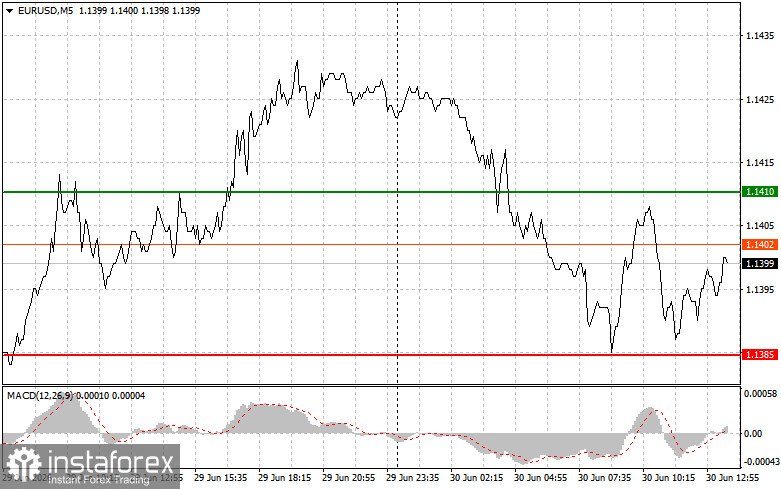
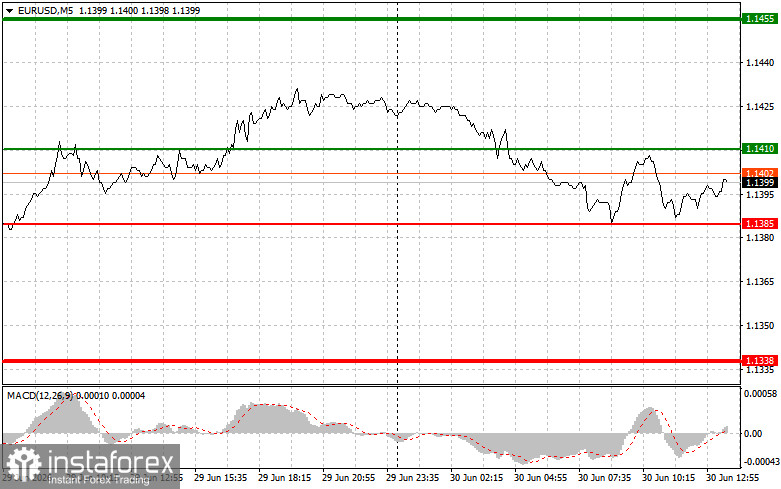
Scenario No. 1: Consider buying the euro if the price reaches 1.1410 (the green line on the chart), with a target at 1.1455. At 1.1455, I plan to exit long positions and consider opening short positions, targeting a 30–35 point move in the opposite direction from the entry point. Further gains in the euro today can be expected as part of a corrective move.
Important: Before buying, make sure the MACD indicator is above the zero line and has just started moving higher.
Scenario No. 2: I also plan to buy the euro if the price tests 1.1385 twice in succession while the MACD indicator is in oversold territory. This would limit the pair's downward potential and could trigger a bullish reversal. In this case, a rise toward 1.1410 and 1.1455 can be expected.
Scenario No. 1: I plan to sell the euro after the price reaches 1.1385 (the red line on the chart). The target will be 1.1338, where I intend to close short positions and immediately consider opening long positions, targeting a 20–25 point rebound. Selling pressure on the pair is likely to return today if U.S. economic data comes in stronger than expected.
Important: Before selling, make sure the MACD indicator is below the zero line and has just started moving lower.
Scenario No. 2: I also plan to sell the euro if the price tests 1.1410 twice in succession while the MACD indicator is in overbought territory. This would limit the pair's upward potential and could trigger a bearish reversal. In this case, a decline toward 1.1385 and 1.1338 can be expected.
Important: Beginner Forex traders should exercise extreme caution when entering the market. It is generally advisable to stay out of the market before the release of major fundamental data to avoid sharp price swings. If you decide to trade during news releases, always use stop-loss orders to limit potential losses. Trading without stop-loss orders can quickly result in losing your entire deposit, particularly if you trade large position sizes without applying proper money management.
Finally, remember that successful trading requires a clear trading plan, such as the one outlined above. Making spontaneous trading decisions based solely on current market conditions is generally a losing strategy for intraday traders.


