
یہ بھی دیکھیں


 02.07.2026 09:01 AM
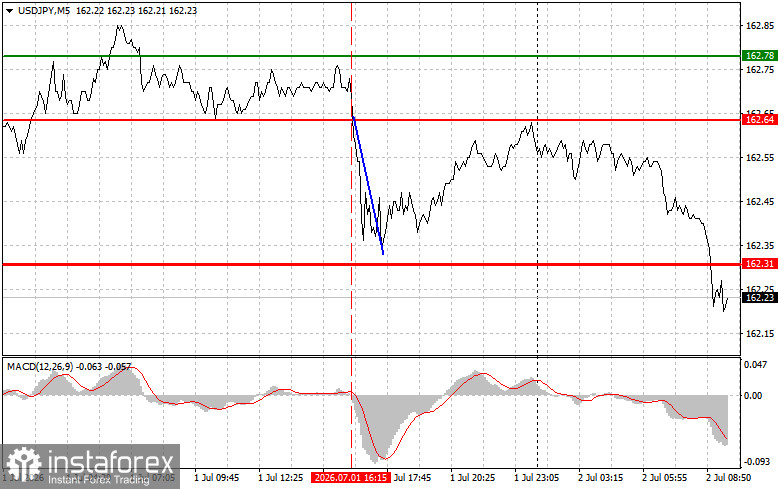
The price test of 162.64 occurred when the MACD indicator was just beginning to move downward from the zero mark, confirming the correct entry point to sell the dollar. As a result, the pair moved up to the target level of 162.31.
Yesterday was marked by significant fluctuations in currency markets, triggered by the appointment of the new Federal Reserve chair, Kevin Warsh. His speech included a key statement that the rapid decline in energy prices gives the central bank an opportunity to act more cautiously when making decisions about future interest rates. This news had a mixed impact on major world currencies, with the U.S. dollar sharply declining. Traders and investors perceived Warsh's words as a signal of a possible slowdown in the pace of rate hikes, traditionally making the U.S. currency less attractive for short-term speculation. Expectations of a more dovish monetary policy eased pressure on the dollar, prompting a wave of selling.
Against this backdrop, the Japanese yen demonstrated moderate growth that persisted into today's Asian session. The fact that the Bank of Japan has solid reasons to consider early interest rate hikes, as business activity remains high and the weakening of the yen risks provoking inflation above target levels, could lead to further declines in the USD/JPY pair in the near future. The market is currently pricing in the possibility of another rate hike by October, which is favorable for the yen and adverse for the dollar.
Regarding the intraday strategy, I will primarily focus on implementing Scenarios #1 and #2.
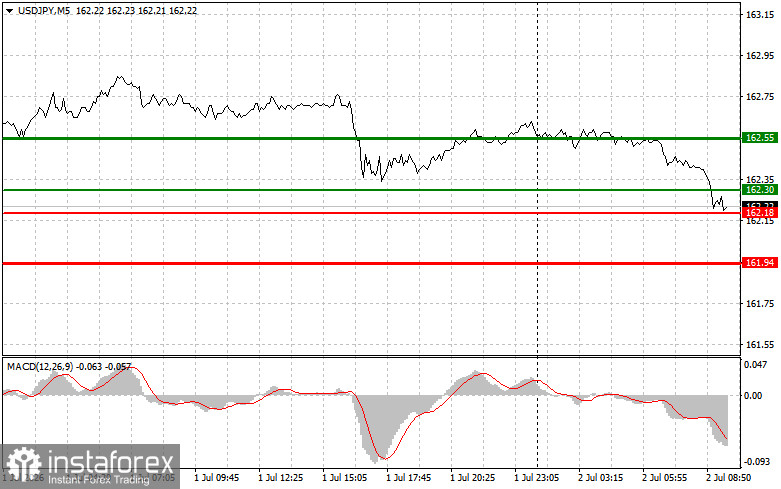
Scenario #1: Today, I plan to buy USD/JPY at an entry point around 162.30 (green line on the chart), with a target of 162.55 (thicker green line on the chart). At 162.55, I intend to exit my long positions and sell the dollar in the opposite direction, expecting a move of 30-35 pips from the entry point. It is best to resume buying the pair during corrections and significant drawdowns in USD/JPY. Important! Before buying, ensure that the MACD indicator is above the zero mark and just starting to rise from it.
Scenario #2: I also plan to buy USD/JPY today in the event of two consecutive tests of the price 162.18 when the MACD indicator is in the oversold area. This will limit the pair's downward potential and lead to an upward market reversal. An increase to the opposing levels of 162.30 and 162.55 can be expected.
Scenario #1: I plan to sell USD/JPY today only after it breaks the level of 162.18 (red line on the chart), which will lead to a rapid decline in the pair. The key target for sellers will be 161.94, where I plan to exit my short positions and immediately buy back in the opposite direction (expecting a move of 20-25 pips in the opposite direction from the level). Sellers may return at any time, at the first hint from the central bank. Important! Before selling, ensure that the MACD indicator is below the zero mark and just starting to decline from it.
Scenario #2: I also plan to sell USD/JPY today in the event of two consecutive tests of the price 162.30 when the MACD indicator is in the overbought area. This will limit the pair's upward potential and lead to a downward market reversal. A decline to the opposing levels of 162.18 and 161.94 can be expected.
Important: Beginning traders in the Forex market must make entry decisions very cautiously. Before the release of significant fundamental reports, it is best to stay out of the market to avoid sudden price fluctuations. If you decide to trade during news releases, always set stop orders to minimize losses. Without stop orders, you can quickly lose your entire deposit, especially if you do not use money management and trade with large volumes.
And remember, for successful trading, it is necessary to have a clear trading plan, similar to the one I have presented above. Making spontaneous trading decisions based on the current market situation is fundamentally a losing strategy for intraday traders.


