
Veja também


 23.03.2026 12:47 AM
The dollar has finally entered a favorable period. Just a few weeks ago, it seemed that any strengthening of the American currency was a temporary phenomenon and that the dollar's fate in 2026 was predetermined. I want to remind you that at the end of last year and the beginning of this year, almost all analysts and economists predicted a new devaluation of the US currency. But what we saw at the end of February and the beginning of March proves once again that in the currency market, one can never be certain about anything. Donald Trump deemed it necessary to neutralize Iran right now, leading to a significant global energy deficit, and the currency market reversed 180 degrees. At this time, I see no reason for a reverse reversal back to the same 180 degrees.
As I mentioned in my recent reviews, we observed seven almost identical waves downwards. Moreover, under the influence of the geopolitical backdrop, there may be even more. Therefore, I would not rely on wave analysis in the near future. For the EUR/USD instrument, it looks much more pleasant, but even there, a decline in quotes may begin with renewed strength as early as Monday.
Next week, only secondary data will come from America. S&P business activity indices, unemployment claims, and the consumer sentiment index. Even the business activity indices are unlikely to attract attention, as market participants will prefer to wait for the ISM indices. I would like to remind you that the market did not see fit to sell the dollar amid weak reports on the labor market, unemployment, and economic growth. Therefore, next week's reports will not pose a significant problem for the dollar. If the geopolitical situation in the Middle East does not worsen day by day, the euro and pound may expect a stronger recovery. However, everything indicates that the conflict will escalate even further, so both instruments may continue to decline.
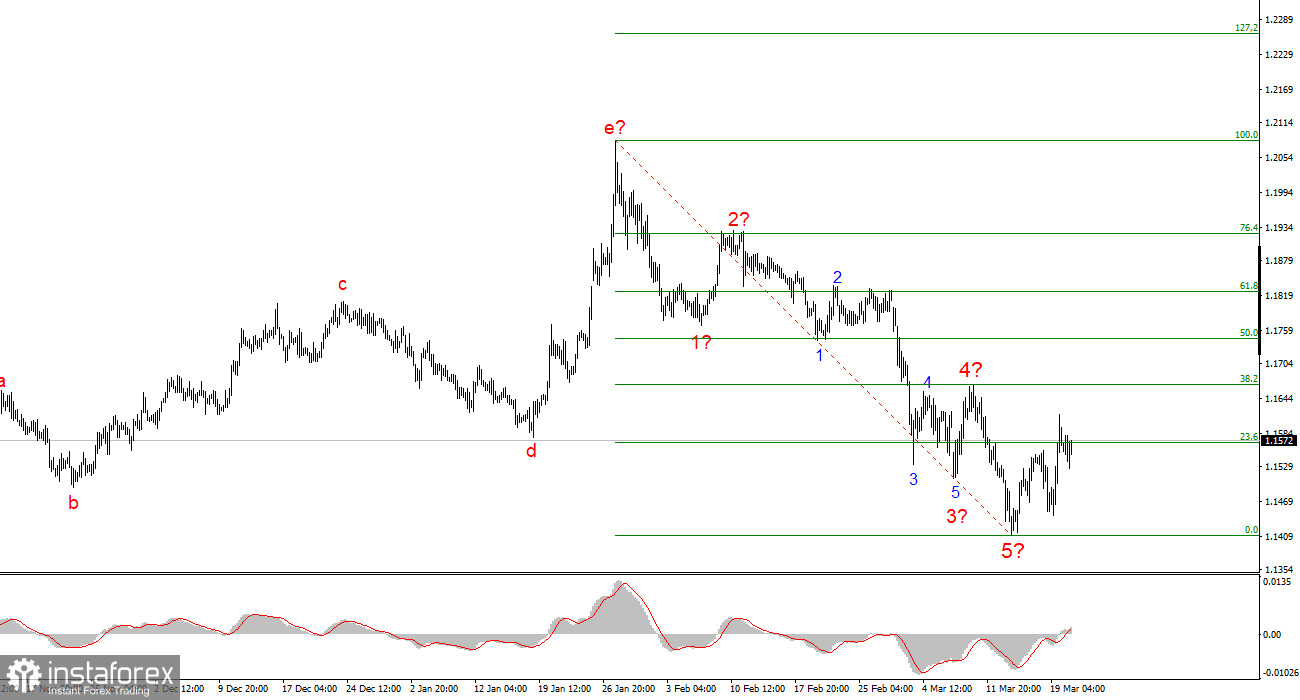
Based on the analysis of EUR/USD, I conclude that the instrument remains within an upward segment of the trend (bottom picture) but has started forming a short-term downward segment. Since the five-wave impulse structure is complete, in the next week or two, my readers can expect an increase in quotes with targets around the levels 1.1568 and 1.1666, which correspond to 23.6% and 38.2% of the Fibonacci. Further movements of the instrument fully depend on events in the Middle East.
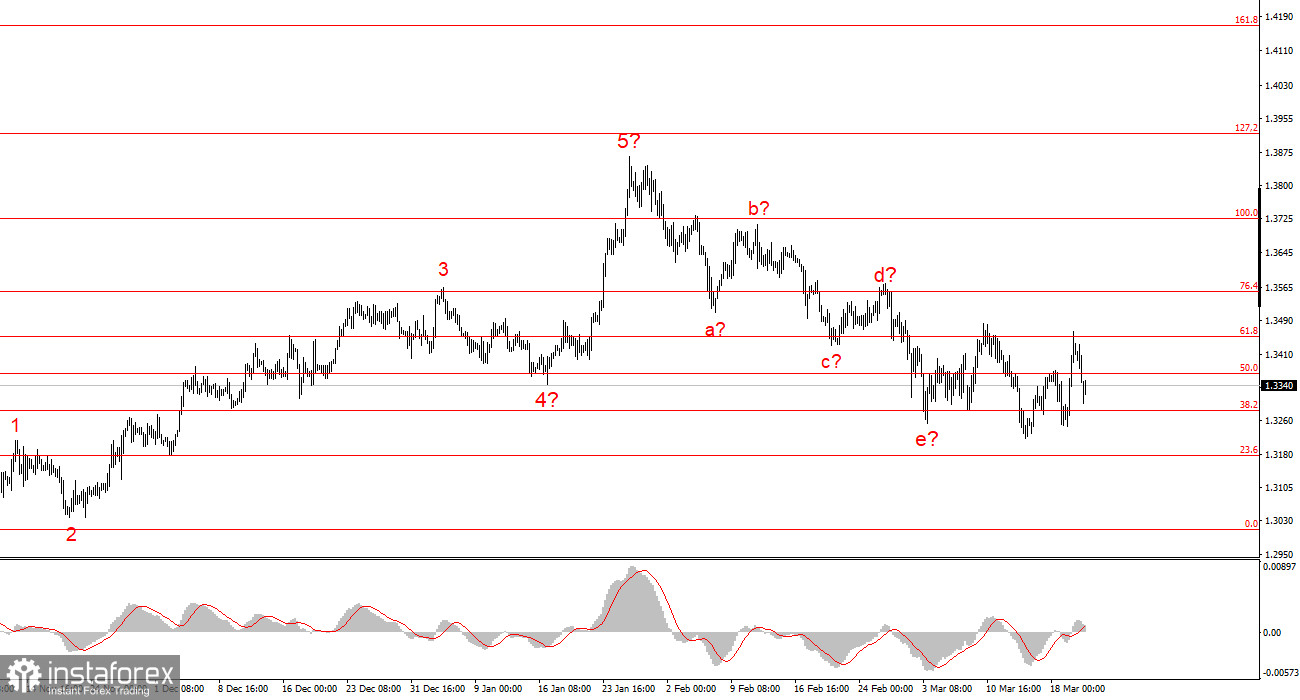
The wave picture for the GBP/USD instrument has become very complex and difficult to read. Now we see a seven-wave downward structure on the charts, which is undoubtedly not that. Most likely, there is elongation or complication within one of the waves. However, this does not make the wave layout clearer. If the wave picture has once been complicated to an unreadable form, it can be complicated several more times. Therefore, I believe it is best to rely on the wave layout of the EUR/USD instrument, which looks much clearer. Also, one should not forget about the geopolitical factor, which can send both instruments into a new decline at any moment. If that does not happen, the euro and the pound can expect an increase within the correction.


