
Lihat juga


 26.06.2026 12:58 PM
Trade Review and Trading Advice for the Japanese Yen
The price test at 161.69 occurred at a time when the MACD indicator had just started moving upward from the zero line, which confirmed a correct entry point for buying the U.S. dollar. As a result, the pair moved up only 5 points and then stalled.
Going forward, the dollar will depend on reports on the U.S. goods trade balance, as well as consumer confidence and inflation expectations indices. The University of Michigan Consumer Sentiment Index serves as a leading indicator reflecting Americans' confidence in their financial situation and the overall state of the economy. Traditionally, high readings are associated with increased consumer spending, which in turn supports economic growth and strengthens the U.S. dollar against the yen. In addition, the market will analyze inflation expectations data. These figures play a crucial role in shaping Federal Reserve policy. A sustained increase in inflation expectations could push the Fed toward tighter monetary policy, although yesterday the dollar showed little reaction to PCE data.
Finally, statements from FOMC members John Williams and Neel Kashkari will provide an additional stream of information. Such speeches often contain signals about future monetary policy steps by the regulator. Investors will be looking for any hints of changes in the interest rate outlook.
As for the intraday strategy, I will continue to rely mainly on scenarios No. 1 and No. 2.
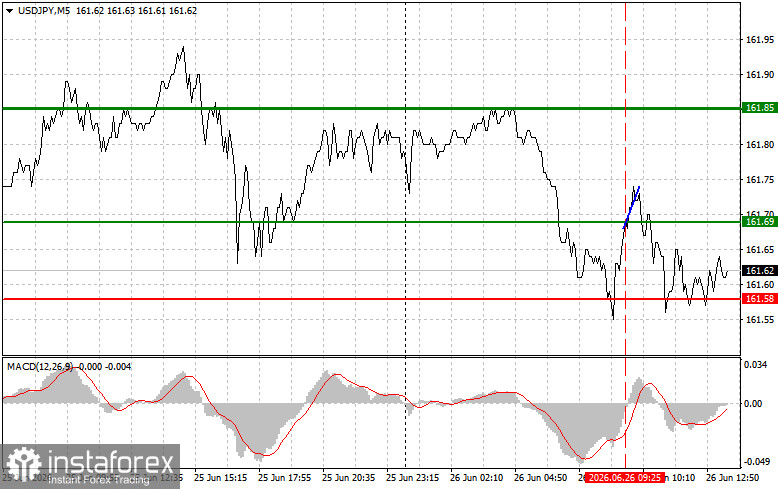
Buy Signal
Scenario No. 1: Today, I plan to buy USD/JPY at an entry point around 161.69 (green line on the chart), targeting a rise toward 161.92 (thicker green line on the chart). At 161.92, I will exit long positions and open short positions in the opposite direction (expecting a 30–35 pip move in the opposite direction). A strong rally in the pair today is possible but remains limited. Important: before buying, ensure that the MACD indicator is above the zero line and has just started rising from it.
Scenario No. 2: I will also consider buying USD/JPY if the price tests 161.55 twice in a row while the MACD indicator is in oversold territory. This would limit downward potential and trigger a reversal to the upside. A move toward the opposite levels at 161.69 and 161.92 can be expected.
Sell Signal
Scenario No. 1: I plan to sell USD/JPY after a break below the 161.55 level (red line on the chart), which may lead to a sharp decline in the pair. The key target for sellers is 161.25, where I will exit short positions and immediately open long positions in the opposite direction (expecting a 20–25 point rebound from that level). Downward pressure on the pair may return in the event of central bank intervention. Important: before selling, ensure that the MACD indicator is below the zero line and has just started moving downward from it.
Scenario No. 2: I will also consider selling USD/JPY if the price tests 161.69 twice in a row while the MACD indicator is in overbought territory. This would limit upward potential and trigger a downward reversal. A decline toward the opposite levels at 161.55 and 161.25 can be expected.
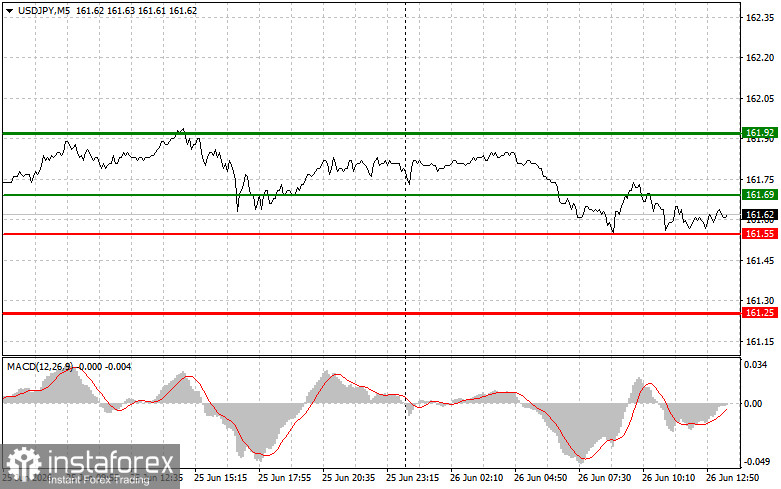
What is shown on the chart:
Important: Beginner Forex traders should be very cautious when making trading decisions. Before the release of important fundamental reports, it is best to stay out of the market to avoid sharp price volatility. If you decide to trade during news releases, always place stop-loss orders to minimize losses. Without stop-loss orders, you can quickly lose your entire deposit, especially if you do not use proper risk management and trade with large volumes.
Remember that successful trading requires a clear trading plan, similar to the one presented above. Making spontaneous trading decisions based on current market conditions is, from the outset, a losing strategy for intraday traders.


