
यह भी देखें


 25.06.2026 06:20 PM
Analysis of Trades and Trading Tips for the Japanese Yen
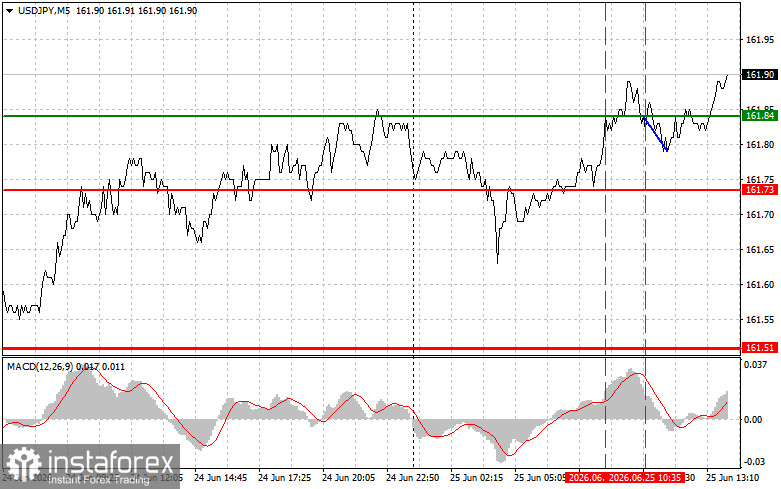
The test of the 161.84 level occurred when the MACD indicator had already moved significantly above the zero line, which limited the pair's upward potential. The second test of 161.84 triggered Sell Scenario No. 2, but the pair failed to develop a significant decline.
Market attention now turns to the upcoming release of a series of key U.S. macroeconomic indicators that will determine the direction of the dollar and set the tone for USD/JPY. The focus will be on first-quarter 2026 U.S. GDP data, which provides an assessment of overall economic growth. If the figure is left unrevised, traders are likely to shift their attention to the Core Personal Consumption Expenditures (Core PCE) Price Index. This indicator, the Federal Reserve's preferred measure of inflation, directly influences expectations regarding future monetary policy. The dynamics of Core PCE are expected to be a key factor in determining the next move of the U.S. dollar. A sharp increase in the index could strengthen hawkish expectations within the Fed and, as a result, support the dollar. Conversely, a slowdown in the indicator could provide additional arguments for policymakers favoring a more accommodative stance and put pressure on the U.S. currency.
Additional insight will come from data on changes in personal income and spending. These indicators provide a more detailed picture of consumer activity and the financial health of U.S. households, which remain one of the primary drivers of the American economy. However, only exceptionally weak U.S. data is likely to put meaningful pressure on the extremely strong bullish trend in USD/JPY.
As for my intraday strategy, I will primarily rely on the implementation of Scenarios No. 1 and No. 2.
Buy Signal
Scenario No. 1: I plan to buy USD/JPY today upon reaching the entry point around 161.95 (green line on the chart), targeting a rise to 162.19 (the thicker green line on the chart). Around 162.19, I plan to exit long positions and open short positions in the opposite direction, targeting a 30–35 point move from that level. Any further gains in the pair today are likely to be relatively limited.
Important! Before buying, make sure that the MACD indicator is above the zero line and is just beginning to move higher.
Scenario No. 2: I also plan to buy USD/JPY today if there are two consecutive tests of the 161.80 level while the MACD indicator is in oversold territory. This would limit the pair's downward potential and trigger a bullish market reversal. In this case, growth toward the opposite levels of 161.95 and 162.19 can be expected.
Sell Signal
Scenario No. 1: I plan to sell USD/JPY today after a break below the 161.80 level (red line on the chart), which would lead to a rapid decline in the pair. The key target for sellers will be 161.51, where I plan to exit short positions and immediately consider opening long positions in the opposite direction, targeting a 20–25 point rebound. Pressure on the pair could return today in the event of intervention by the central bank.
Important! Before selling, make sure that the MACD indicator is below the zero line and is just beginning to move lower.
Scenario No. 2: I also plan to sell USD/JPY today if there are two consecutive tests of the 161.95 level while the MACD indicator is in overbought territory. This would limit the pair's upward potential and trigger a bearish market reversal. In this case, a decline toward the opposite levels of 161.80 and 161.51 can be expected.
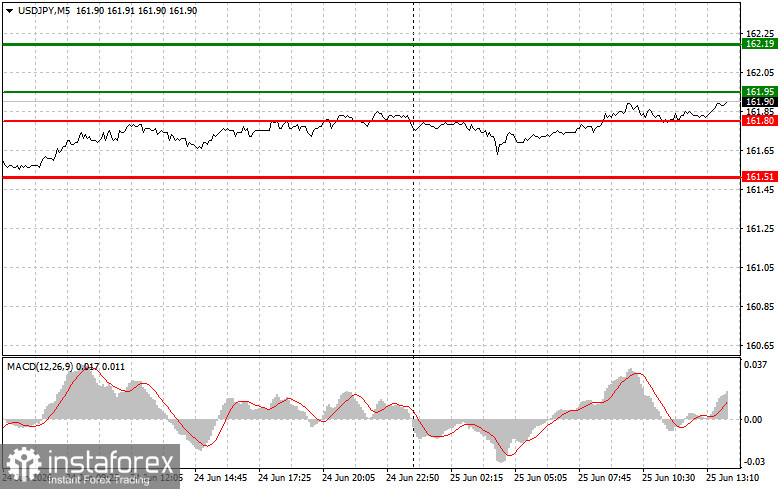
Chart Notes:
Important. Beginner Forex traders should exercise extreme caution when making market entry decisions. It is best to stay out of the market ahead of major fundamental reports to avoid exposure to sharp price swings. If you choose to trade during news releases, always use stop-loss orders to minimize potential losses. Without stop-loss orders, you can lose your entire deposit very quickly, especially if you trade large positions without applying proper money management.
Remember that successful trading requires a clear trading plan, such as the one outlined above. Making spontaneous trading decisions based solely on the current market situation is inherently a losing strategy for an intraday trader.

