
यह भी देखें


 16.09.2026 06:27 PM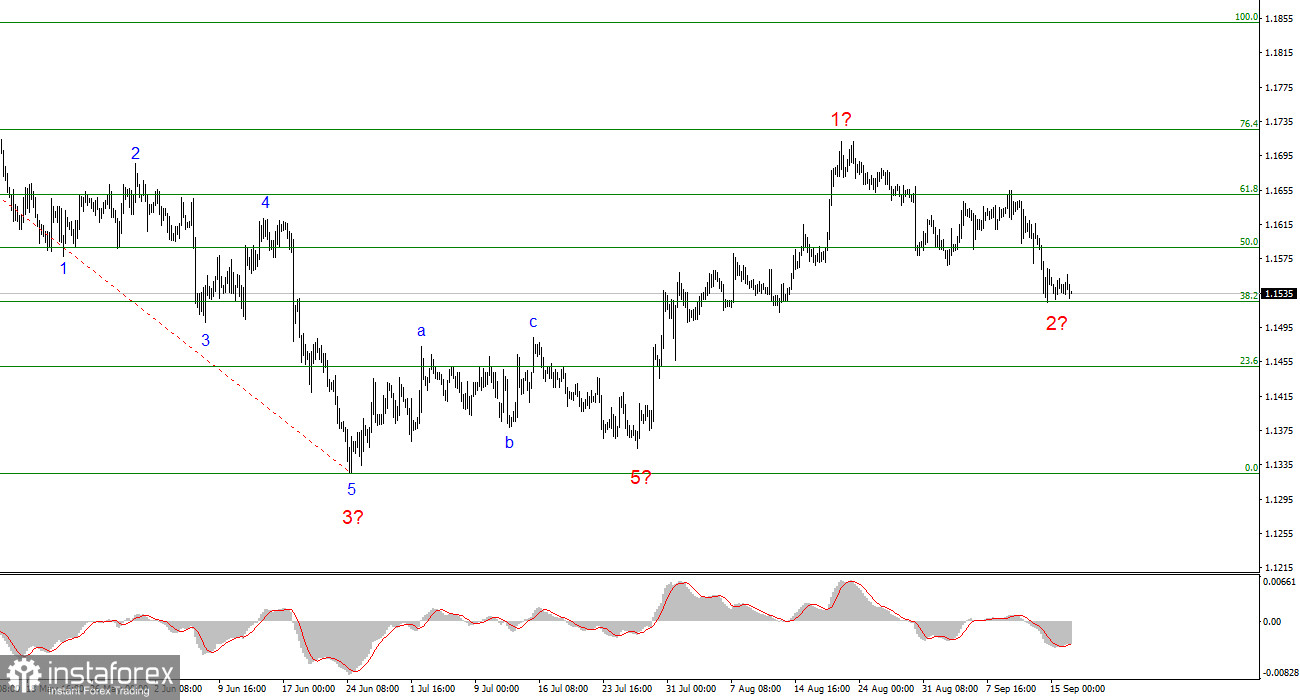
The wave count on the 4-hour chart for EUR/USD is becoming more complex. There is still no question of invalidating the upward trend segment (lower chart), which began in January last year. On the contrary, we have seen a complete A-B-C corrective structure, which has most likely been completed. We never saw a convincing wave 5 within wave C. This wave took a truncated form, which also occurs from time to time. Let me remind you that classic wave structures are generally found only in textbooks. In real-life trading, traders and analysts should be more flexible in their analysis.
The wave count may also transform into a more complex structure again. Wave C may take a three-wave form, the subsequent wave would then be identified as wave D, and the entire trend segment beginning on January 27 would take the five-wave corrective form A-B-C-D-E. If this assumption is correct, wave D will take a three-wave form, and on August 21, EUR/USD entered the phase of forming wave E, whose low should be below the low of wave C at 1.1325. At the same time, however, this scenario is an alternative one. Based on the news backdrop, I am more inclined to expect the formation of a global upward wave and upward trend segment.
The 1.1525 level is preventing the euro from falling again.
The EUR/USD rate remained virtually unchanged throughout Wednesday. However, no one doubts that the market will face significant volatility this evening. It is still not entirely clear which direction this volatility will take. More precisely, it is completely unclear. The possibility of a stronger US currency is supported by the fact that, theoretically, the Fed may adopt a "pro-hawkish" stance not only regarding the September meeting but also much further into the future. The possibility of a weaker US currency is supported by the fact that demand for the currency has increased in recent days. Consequently, market participants have been actively pricing in a hawkish FOMC decision, and today they may begin taking profits. It appears that this evening we may see varying interpretations of events. In other words, the market may see whatever it wants to see.
I would like to remind you that after the first Fed meeting under Kevin Warsh, demand for the currency increased sharply even though the interest rate remained unchanged. The reason was that, in June, the market became convinced of Warsh's independence and of a hawkish direction for monetary policy over the next six months or year. As of September, I still doubt that the Fed will maintain a genuinely hawkish stance for an extended period rather than simply give the markets a gift ahead of the upcoming holiday. Let me remind you that US bond yields continue to set records almost every day. A Fed rate hike would push yields even higher, slow economic growth, and cool the labor market. For now, I do not believe there will be more than one round of policy tightening. And that round was already priced back in June.
General Conclusions
Based on my EUR/USD analysis, I conclude that the pair remains within a local upward trend segment. I would note that the trend segment beginning in January of this year may still take the form A-B-C-D-E. If this assumption is correct, the decline in quotes will resume, with targets below the low of wave C at 1.1325. However, I currently consider this scenario an alternative one. I believe that the formation of a new upward trend segment began in June, which will return the euro to the 20th figure and take it significantly above that level. Therefore, I remain inclined toward buying, with targets above the 17th level.
On the higher time frame, an upward trend segment can be seen, followed by the formation of an A-B-C corrective structure. This structure may take a five-wave form, but at the current moment, I consider it complete. If this is the case, the formation of a new impulsive upward trend segment has begun.
The main principles of my analysis:

