
Veja também


 20.05.2026 08:21 AM
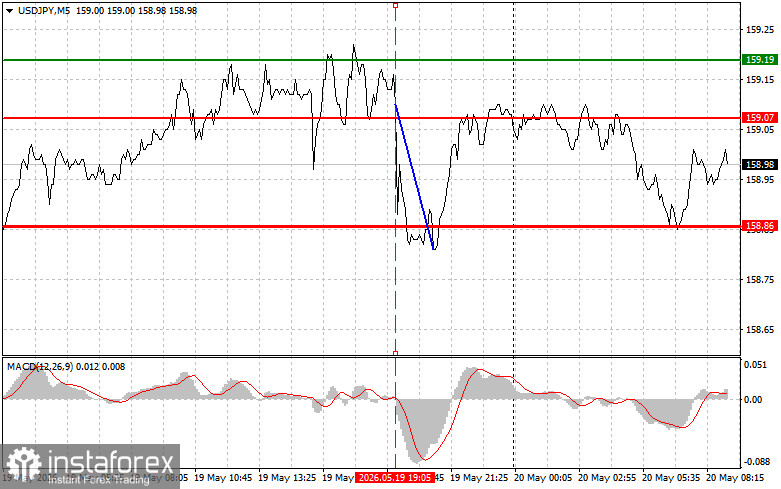
The price test at 159.07 coincided with the MACD indicator just beginning to move downward from the zero mark, confirming the correct entry point for selling the dollar. As a result, the pair declined by almost 20 pips.
The balance of power in the USD/JPY pair has not changed significantly compared to the previous trading day. Despite U.S. President Donald Trump's public abandonment of initial plans for an immediate military strike on Iran, this factor did not lead to the expected strengthening of the Japanese yen. The market has likely exhausted its reaction to this news, or other, more significant factors continue to dominate price formation.
It seems that only direct currency interventions by the Bank of Japan will be able to stop the current rise in Japanese government bond yields and the yen's decline. This rise, in turn, pushes USD/JPY higher, making the Japanese currency less attractive compared to the U.S. dollar, whose yields remain higher. If the BoJ decides to intervene actively to stabilize the yen's exchange rate, it could be a key factor in reversing the current trend. Without such decisive actions from the Japanese central bank, the USD/JPY pair will likely retain its upward trend.
Regarding the intraday strategy, I will focus on implementing Scenarios No. 1 and No. 2.
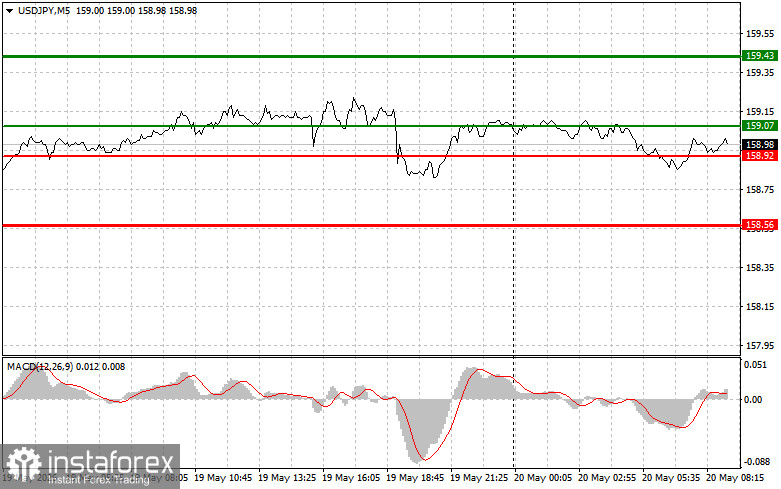
Scenario No. 1: I plan to buy USD/JPY today upon reaching an entry point around 159.07 (green line on the chart), with a target for growth at 159.43 (thicker green line on the chart). At level 159.43, I intend to exit the long positions and sell back in anticipation of a 30-35-pip move from the entry point. It is best to resume buying the pair on corrections and significant USD/JPY drawdowns. Important! Before buying, ensure that the MACD indicator is above the zero mark and is just beginning to rise from that level.
Scenario No. 2: I also plan to buy USD/JPY today in the case of two consecutive tests of the price 158.92 when the MACD indicator is in the oversold zone. This will limit the pair's downward potential and lead to an upward market reversal. One can expect growth toward the opposite levels of 159.07 and 159.43.
Scenario No. 1: I plan to sell USD/JPY today only after the 158.92 level is updated (red line on the chart), which will trigger a rapid decline in the pair. The key target for sellers will be level 158.56, where I intend to exit the short positions and immediately buy back in the opposite direction (anticipating a 20-25-pip move in the opposite direction from the level). Sellers may return at any moment; it takes only a hint from the central bank. Important! Before selling, ensure the MACD indicator is below the zero mark and just beginning to decline from that level.
Scenario No. 2: I also plan to sell USD/JPY today in the case of two consecutive tests of the price 159.07 when the MACD indicator is in the overbought zone. This will limit the pair's upward potential and lead to a market reversal downward. One can expect a decline toward the opposite levels of 158.92 and 158.56.
Important: Beginner traders in the Forex market need to make entry decisions very cautiously. It is best to stay out of the market before important fundamental reports to avoid sharp price fluctuations. If you decide to trade during news releases, always set stop orders to minimize losses. Without placing stop orders, you can quickly lose your entire deposit, especially if you do not use money management and trade in large volumes.
And remember, for successful trading, it is essential to have a clear trading plan, as outlined above. Making impulsive trading decisions based on the current market situation is fundamentally a losing strategy for an intraday trader.


