
Vea también


 02.02.2026 01:01 PM
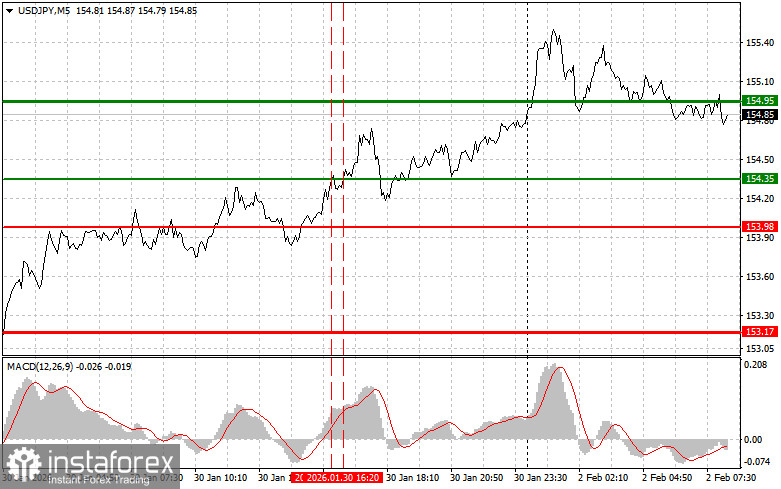
The price test of 154.35 coincided with a moment when the MACD indicator had already moved significantly upward from the zero line, which limited the pair's upward potential. The second test of 154.35 provided a sell entry according to Scenario No. 2, but a full sell-off of the pair did not follow.
An unexpected pause in the decline of the U.S. Producer Price Index (PPI), contrary to the forecasts of many experts, led to a strengthening of the U.S. dollar and a weakening of the Japanese yen. Japan's Manufacturing PMI released today matched economists' expectations, coming in at 51.5 points. The stability of Japan's manufacturing sector reflected in this index indicates continued moderate growth in the country's economy. The absence of unexpected deviations from forecast values suggests predictability in the current economic environment and allows businesses to plan their operations more effectively. An increase in the PMI is a positive sign, pointing to growth in production, employment, and new orders. In the context of global economic instability, maintaining positive PMI values inspires optimism about the outlook for the Japanese economy. However, this did not trigger any strengthening of the Japanese yen.
As for the intraday strategy, I will rely primarily on the implementation of Scenarios No. 1 and No. 2.
Buy Scenarios
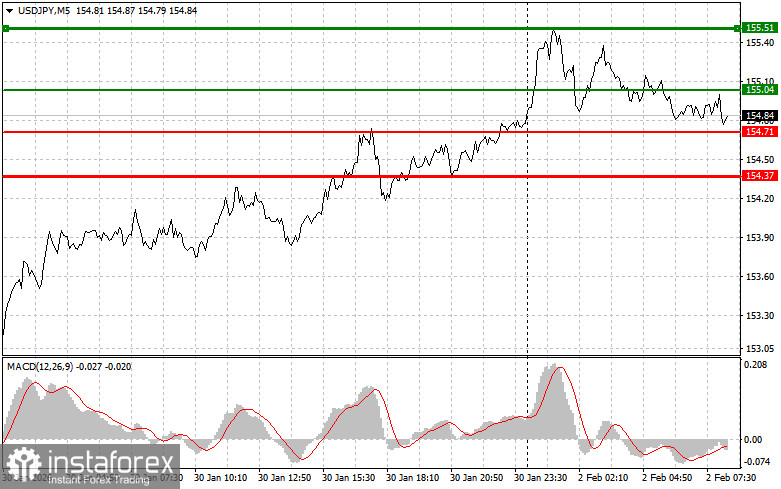
Today, I plan to buy USD/JPY if the price reaches the entry level around 155.04 (thin green line on the chart), with a target move toward 155.51 (thicker green line on the chart). Around 155.51, I plan to exit long positions and open short positions in the opposite direction, aiming for a 30–35 point move from that level. It is best to return to buying the pair on corrections and significant pullbacks in USD/JPY.
Important! Before buying, make sure the MACD indicator is above the zero line and just beginning to rise from it.
I also plan to buy USD/JPY today in the case of two consecutive tests of the 154.71 level, at a moment when the MACD indicator is in the oversold area. This would limit the pair's downward potential and lead to an upward market reversal. Growth toward the opposite levels 155.04 and 155.51 can be expected.
Sell Scenarios
Today, I plan to sell USD/JPY only after the 154.71 level is broken (red line on the chart), which would lead to a rapid decline in the pair. The key target for sellers will be 154.37, where I plan to exit short positions and immediately open buy trades in the opposite direction, aiming for a 20–25 point rebound from that level. It is better to sell as high as possible.
Important! Before selling, make sure the MACD indicator is below the zero line and just beginning to decline from it.
I also plan to sell USD/JPY today in the case of two consecutive tests of the 155.04 level, when the MACD indicator is in the overbought area. This would limit the pair's upward potential and lead to a downward market reversal. A decline toward the opposite levels 154.71 and 154.37 can be expected.
What's on the Chart:
Important:
Beginner Forex traders should make market entry decisions with great caution. Before the release of major fundamental reports, it is best to stay out of the market to avoid sharp price fluctuations. If you decide to trade during news releases, always use stop-loss orders to minimize losses. Without stop-loss orders, you can lose your entire deposit very quickly—especially if you do not use proper money management and trade large volumes.
And remember: successful trading requires a clear trading plan, such as the one presented above. Making spontaneous trading decisions based on the current market situation is inherently a losing strategy for an intraday trader.


