Vea también


 01.07.2026 01:11 AM
The EUR/JPY pair demonstrates a slight increase on Tuesday, and at the time of publication, it has slightly pulled back to the 50-day SMA. The exchange rate is around 185.18, having risen 0.07% for the day. The stability of the euro supports the pair despite German inflation data coming in below forecasts. Meanwhile, the Japanese yen continues to face pressure, despite repeated warnings from Tokyo officials about excessive fluctuations in the currency's rate.
Published data from Germany showed that inflation in June weakened much more than expected. The consumer price index (CPI) increased by 2.3% year-on-year, down from 2.6% in May and below the market forecast of 2.5%. The harmonized index of consumer prices (HICP)—a key inflation indicator for the European Central Bank—also fell short of expectations, rising by 2.4% year-on-year (compared to 2.7% previously) and decreasing by 0.2% month-on-month.
These figures provide further evidence of easing inflationary pressure in the largest economy in the Eurozone. Earlier that same day, the head of the Dutch central bank, Klaas Knot, noted that falling energy prices due to easing tensions in the Middle East should contribute to a further deceleration in inflation. However, ECB representatives Pierre Wunsch and Joachim Nagel warned that inflation may remain above the target of 2% for several quarters, as the geopolitical situation remains extremely uncertain.
Investors also focused on Germany's retail sales data, which exceeded forecasts. According to the statistics office Destatis, retail sales increased by 1.1% month-on-month and 1.8% year-on-year in May, surpassing market expectations and indicating resilience in consumer spending despite heightened inflation.
Now, market participants are awaiting the publication of preliminary HICP data for the Eurozone, scheduled for Wednesday; this information may provide additional guidance regarding future changes in the ECB's interest rates. The Japanese yen continues to be supported by the risk of currency interventions. Chief Cabinet Secretary Minoru Kihara reiterated the authorities' readiness to take action in the currency market if necessary, while Finance Minister Satsuki Katayama noted that the government would be prepared to respond to currency rate fluctuations as needed. At the same time, ongoing discussions within the Bank of Japan continue to strengthen expectations of gradual normalization of monetary policy, although the persistently low interest rates in Japan still limit the yen's attractiveness.
From a technical perspective, the pair is trading within a sideways trend in the current range, and oscillators are neutral, confirming the lateral movement. However, it is worth noting that the bulls have surpassed all moving averages, indicating a higher likelihood of growth for the pair. Additionally, the 200-day SMA is tilted upward, confirming that, from a long-term perspective, the pair should rise.
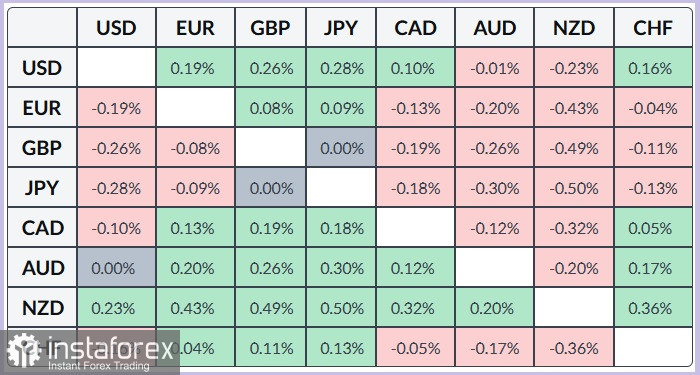
The table below displays the percentage change in the euro exchange rate against major currencies for Tuesday. The largest growth of the euro is observed against the Japanese yen.