
Vea también


 17.08.2026 01:58 PM
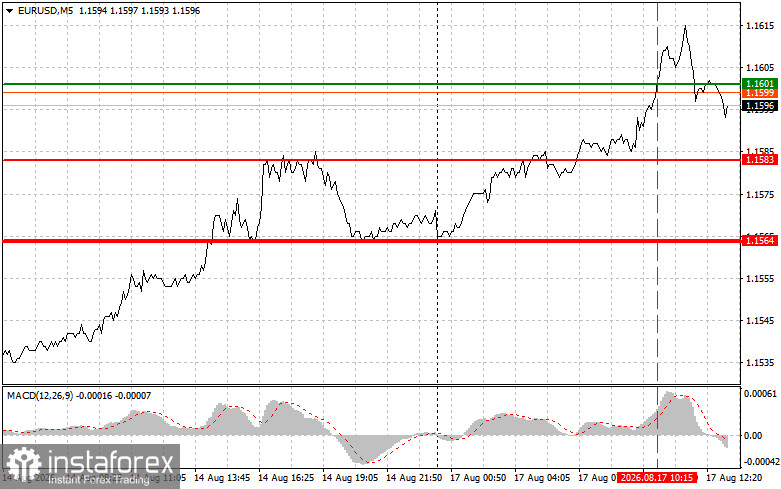
The test of 1.1601 occurred when the MACD indicator had already moved significantly above the zero line, which limited the pair's upward potential. For this reason, I did not buy the euro.
The empty economic calendar for the eurozone worked in favor of the single currency, triggering some buying within the ongoing bullish trend. However, the pair did not make a significant move higher. Dollar weakness, rather than demand for the euro, was the main driver, and traders took advantage of the opportunity to try to extend the upward move. This is why EUR/USD continued to rise despite the lack of domestic catalysts.
The euro will spend the second half of the day in a relatively calm environment, as no significant US data are expected. The agenda includes only the Empire Manufacturing Index and the NAHB Housing Market Index, both of which are considered secondary indicators. The Empire Manufacturing Index provides an early snapshot of business activity in the manufacturing sector, while the NAHB index reflects homebuilder confidence. However, both indicators carry limited weight for the market and do not usually trigger sharp reactions. For the single currency, this means that the external market backdrop will remain the main driver. Only a significant deviation of the data from forecasts could alter the current balance of forces, while results in line with expectations will leave EUR/USD primarily driven by sentiment toward the US dollar.
As for the intraday strategy, I will focus more on implementing Scenarios #1 and #2.
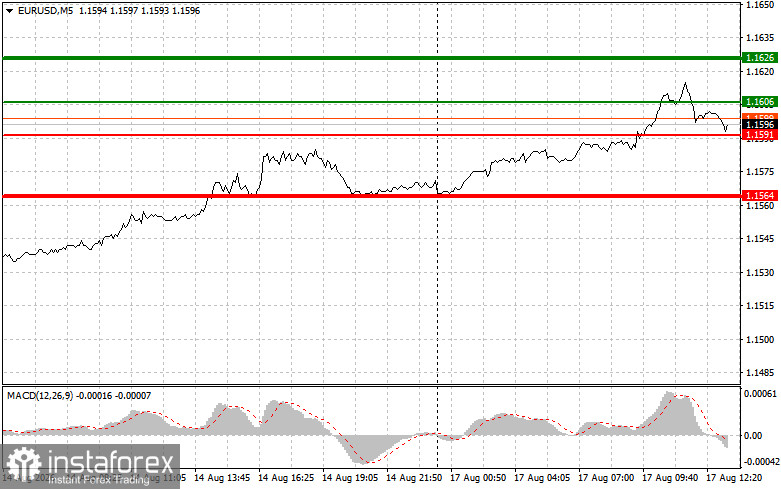
Scenario #1: Today, the euro can be bought when the price reaches around 1.1606 (the green line on the chart), with a target of 1.1626. At 1.1626, I plan to exit the market and also sell the euro in the opposite direction, targeting a move of 30–35 points from the entry point. A rise in the euro today can be expected only following weak US data. Important: Before buying, make sure that the MACD indicator is above the zero line and is just beginning to rise from it.
Scenario #2: Today, I also plan to buy the euro if the price tests 1.1591 twice consecutively while the MACD indicator is in the oversold zone. This will limit the pair's downward potential and lead to an upward reversal. A rise toward the opposite levels of 1.1606 and 1.1626 can be expected.
Scenario #1: I plan to sell the euro after the price reaches 1.1591 (the red line on the chart). The target will be 1.1564, where I plan to exit the market and immediately buy in the opposite direction, targeting a 20–25-point move in the opposite direction from the level. Downward pressure on the pair will return following strong data. Important: Before selling, make sure that the MACD indicator is below the zero line and is just beginning to decline from it.
Scenario #2: Today, I also plan to sell the euro if the price tests 1.1606 twice consecutively while the MACD indicator is in the overbought zone. This will limit the pair's upward potential and lead to a downward reversal. A decline toward the opposite levels of 1.1591 and 1.1564 can be expected.
Important. Beginner Forex traders should be very cautious when making market-entry decisions. Before the release of important fundamental reports, it is best to stay out of the market to avoid being caught in sharp price fluctuations. If you decide to trade during news releases, always place stop orders to minimize losses. Without stop orders, you can lose your entire deposit very quickly, especially if you do not use proper money management and trade large volumes.
And remember that successful trading requires a clear trading plan, such as the one presented above. Making spontaneous trading decisions based on the current market situation is inherently a losing strategy for an intraday trader.


