
Vea también


 08.09.2026 12:39 AM
The British economy continues to show paradoxical resilience. The August composite PMI unexpectedly accelerated to 52.5, reaching a four-month high, driven by a confident rise in the services sector, which jumped to 52.8 — the best reading in six months. At the same time, manufacturing activity slowed to a five-month low of 51.5, indicating the exhaustion of the preventive stockpiling effect.
Mortgage lending collapsed in July to £4.3 billion from £7.7 billion in June, and the number of approved house-urchase applications fell to 56,100 — the lowest since January 2024, while the market had expected an increase to 59,000. The effective rate on new mortgages, meanwhile, rose to 4.45%, and this increase is already pushing buyers out of the market. The paradox is that amid the collapse in mortgage lending, consumer credit reached a peak not seen since November 2025, rising to £2.0 billion.
Bank of England Governor Andrew Bailey, in his first public comment since the July meeting, confirmed that secondary inflationary effects remain "quite moderate," and the labor market continues to show signs of weakening. The BoE is not yet prepared to yield to pressure from accelerating inflation. However, there has long been no unanimity at the BoE. Markets have fully priced a 25 bp rate hike to 4% by the end of the year and consider a high probability of a second increase in the spring of next year.
The conflict in the Persian Gulf continues to exert direct pressure on the European energy market; UK gas (NBP) approached 183 pence per therm, reaching a high not seen since late 2023. For the UK as a net energy importer, this means any new escalation will directly hit inflation and the balance of payments, and Bailey effectively acknowledged this in his speech, saying he "cannot guarantee the current situation will persist."
Domestic data point to a slowdown in rate-sensitive sectors. In the coming weeks,, the key issue will be less the reaction to data and more the BoE's willingness to remain on pause despite accelerating inflation and growing hawkish pressure.
As shown in the CFTC report published on Friday, the net short position on the pound has slightly increased to ?£4.23 billion; the estimated price remains above the long-term average, but the momentum is weak.
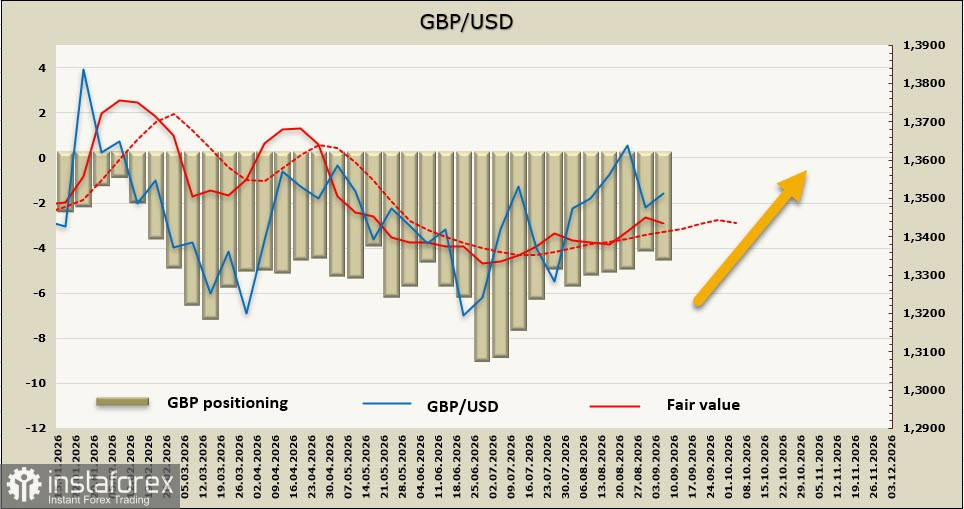
In the previous review,, we expected the pound's decline to be shallow and for it to resume rising, not falling below the 1.3440–1.3460 support. Indeed, the pound corrected shallowly and is now attempting to resume its ascent. Ahead of the US inflation report, trading will be mostly range-bound with a slight upward bias; thereafter, everything will depend on how the market adjusts its Fed-rate forecast. The bullish scenario looks somewhat more likely, in which case GBP/USD will attempt to return to the summer high of 1.3674.


