
Vea también


 30.06.2026 11:41 AM
Gold (XAU/USD) is struggling to halt its decline, holding just above the psychological $4,000 level while showing limited price movement. Rising geopolitical tensions in the Middle East, together with conflicting signals in the dialogue between the United States and Iran, are driving renewed demand for the U.S. dollar as a safe-haven asset. This has paused the recent correction in the U.S. Dollar Index from its June high, which had previously been reached in May 2025.
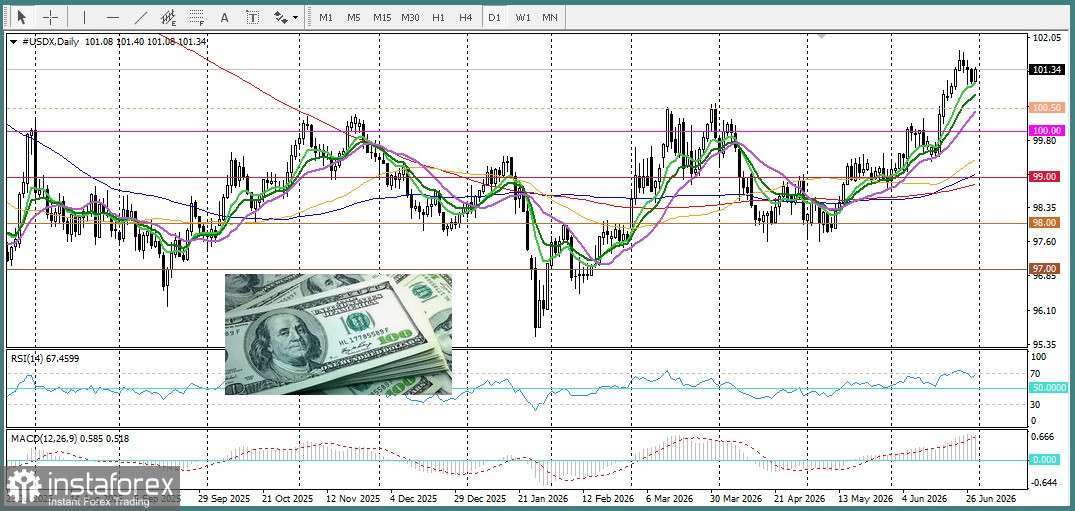
According to media reports, Washington and Tehran have reached agreements aimed at reducing tensions following recent clashes near the Strait of Hormuz, although both sides continue to accuse each other of violating the ceasefire. The situation became more complicated after Donald Trump claimed on Truth Social that Iran had initiated a meeting in Doha, Qatar. At the same time, Iranian Deputy Foreign Minister Kazem Gharibabadi denied reports that technical negotiations were planned for this week. This uncertainty continues to sustain elevated geopolitical risks and reinforces the U.S. dollar's position as a safe-haven asset.
At the same time, the escalation of the conflict has intensified inflation concerns, which, together with the Federal Reserve's more hawkish rhetoric, has strengthened market expectations of higher interest rates. According to the CME Group FedWatch Tool, the probability of a rate hike in September is estimated at around 63%, while the probability of further monetary tightening by the end of the year exceeds 80%. These expectations are boosting demand for the U.S. dollar and encouraging capital outflows from gold, which does not generate interest income.
Another negative factor was the weakening of the Japanese yen to its lowest level against the U.S. dollar in nearly forty years, which also weighed on the precious metals market.
On Tuesday, the market's attention is focused on U.S. macroeconomic releases, including the Conference Board Consumer Confidence Index and the JOLTS Job Openings report. However, the key event will be Federal Reserve official Kevin Warsh's speech on Thursday at the ECB Forum in Sintra.
The U.S. Nonfarm Payrolls (NFP) report is also expected to have a significant impact on both the U.S. dollar and gold, as it may provide additional signals regarding the future direction of Federal Reserve monetary policy.
From a technical perspective, gold has shown resilience below the $3,960 level and is attempting to stabilize while seeking to establish itself above the psychological $4,000 level. Oscillators remain in negative territory, indicating that bears retain the advantage. However, the Relative Strength Index (RSI) is approaching oversold territory, suggesting that selling pressure is easing. Nevertheless, there is still no confirmation of a bullish reversal. The nearest resistance is located at the psychological $4,100 level. A sustained break above this level could strengthen bullish momentum.


