
আরও দেখুন


 16.04.2026 03:58 AM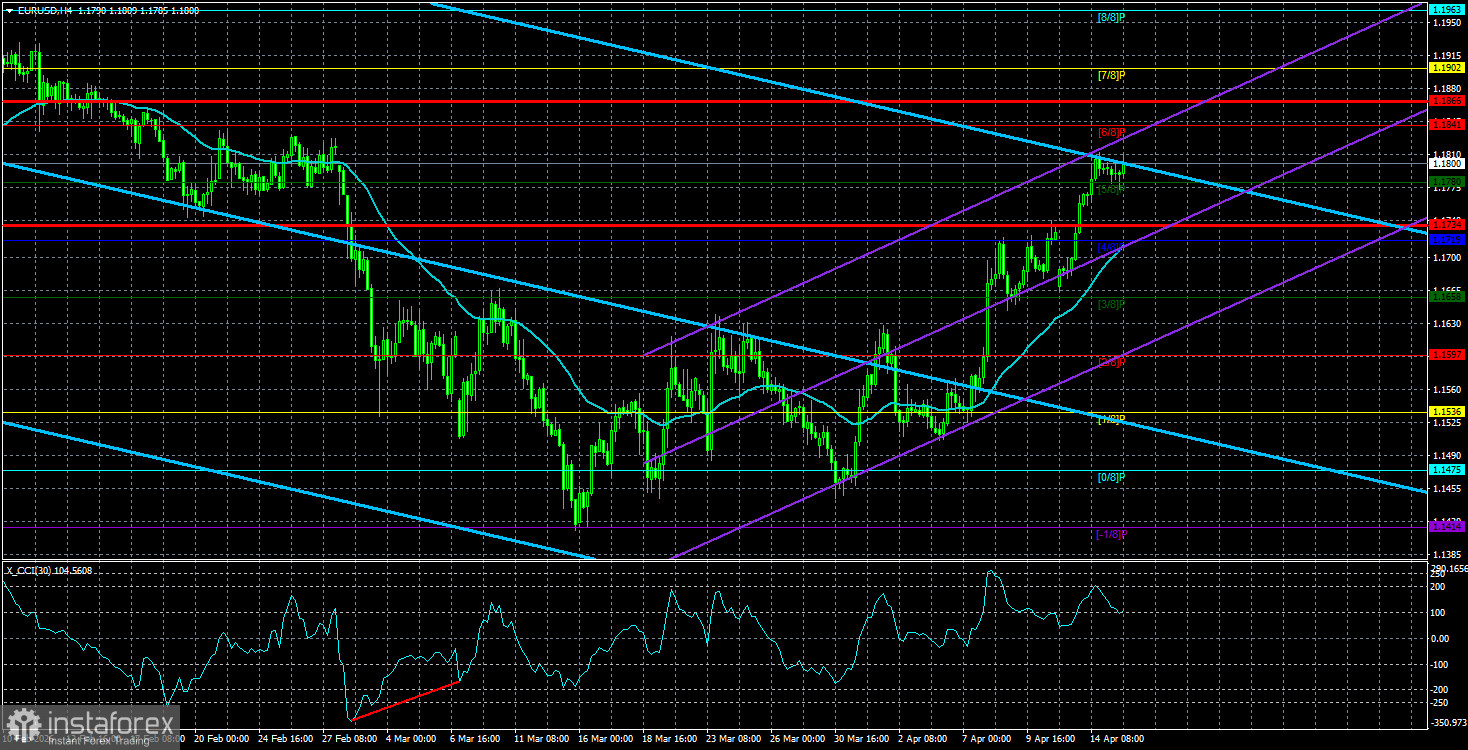
The EUR/USD currency pair failed to extend its upward move on Wednesday, raising alarms among many experts. In their opinion, the bulls have squeezed the most out of the current situation, and further upward movement will require solid reasons. We believe this is both true and not entirely correct. It is important to note that over the past week and a half, the euro has easily and simply recovered more than 50% from its preceding decline, based solely on market belief that the war in the Middle East has ended and that the Strait of Hormuz will eventually be unblocked. Essentially, traders did not even need specifics on this broad topic that had dragged the EUR/USD pair down for two consecutive months.
What can we confidently discuss now? Only that there are currently no hostilities in the Middle East. This is a fact, and it is a positive fact. At the same time, the Strait of Hormuz remains blocked, and it is unknown how long it will remain so. Negotiations with Iran have de facto not been concluded, but they are also not currently ongoing. No ceasefire agreements have been announced. All we see is a cessation of hostilities.
It's worth reminding that this very scenario was indirectly voiced by some experts, including us. Donald Trump has been unable and will not be able to force Iran to abandon its nuclear developments and weapons, which has left America in a stalemate. The goals have not been achieved (whatever Trump might say), and further conflict cannot proceed without risking the loss of both chambers of Congress in November. As a result, Trump and JD Vance have repeatedly stated that America has won and that continuing the fight is pointless, as all goals have been achieved. By the way, what these "achieved goals" are remains unknown. The U.S. president has wanted to denuclearize Iran for two years straight, and for two years, he has achieved nothing. What were the other objectives? To kill Ali Khamenei? What would that have accomplished when Tehran's political course remains unchanged?
Thus, the conflict cannot be considered resolved. It should be noted that last year, Trump struck Iranian nuclear facilities, and then the conflict in the Middle East seemed to have exhausted itself. After all, Trump then proclaimed the total destruction of Iran's nuclear potential. We wouldn't be surprised if, after the elections, Trump announces that Iran is ready to launch nuclear missiles at the U.S. tomorrow, necessitating a new military operation. And everything will start over. It is crucial for Trump not to lose the elections in Congress completely; after that, his rhetoric may undergo significant changes. We are nearly certain that Iran understands this. As for the dollar's decline, the shelf life of the geopolitical factor has simply expired. What does the U.S. dollar have left in its arsenal? Nothing. On the daily timeframe, the pair has tested the Senkou Span B line of the Ichimoku indicator, which accounts for the pause observed now.
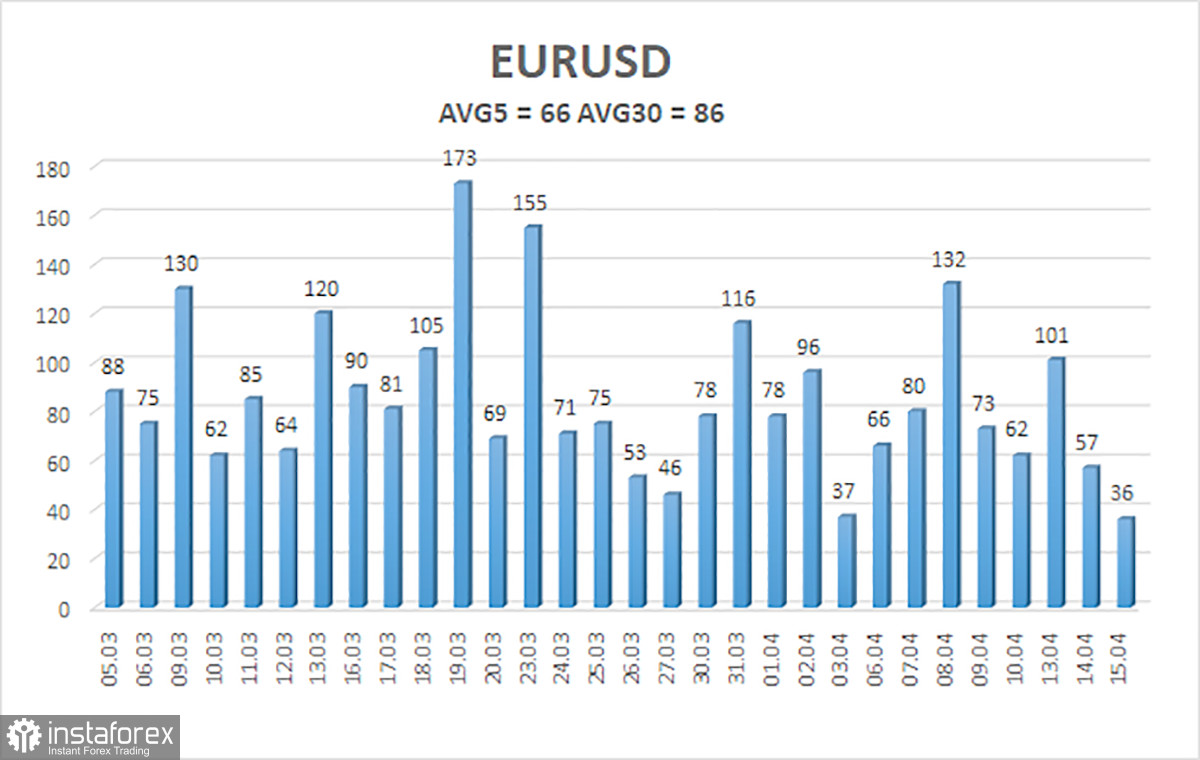
The average volatility of the EUR/USD currency pair over the last five trading days as of April 16 is 66 pips, characterized as "average." We expect the pair to move between 1.1734 and 1.1866 on Thursday. The upper channel of the linear regression has turned downward, indicating a shift in trend to a downward one. However, an upward trend may actually resume at this time. The CCI indicator has entered the overbought area and formed a "bearish" divergence, warning of a possible downward pullback in the near future.
S1 – 1.1780
S2 – 1.1719
S3 – 1.1658
R1 – 1.1841
R2 – 1.1902
R3 – 1.1963
The EUR/USD pair has started its upward movement, but its continuation will again depend on geopolitics. The global fundamental backdrop for the dollar remains extremely negative, so in the long term, we still expect the pair to grow. If the price is below the moving average, short positions can be considered with targets at 1.1658 and 1.1597. Above the moving average line, long positions remain relevant with targets at 1.1841 and 1.1866. The market is gradually distancing itself from geopolitical factors, and familiar economic factors may come to the fore in the near future.
Regression channels help determine the current trend. If both are directed in the same way, it indicates a strong trend.
The moving average line (settings 20.0, smoothed) defines the short-term trend and direction in which trading should proceed.
Murray levels serve as target levels for movements and corrections.
Volatility levels (red lines) indicate the probable price channel in which the pair is likely to trade over the next day, based on current volatility readings.
The CCI indicator's entry into the oversold area (below -250) or the overbought area (above +250) indicates that a trend reversal in the opposite direction is approaching.


